Case study · Reuse · Honest valuations
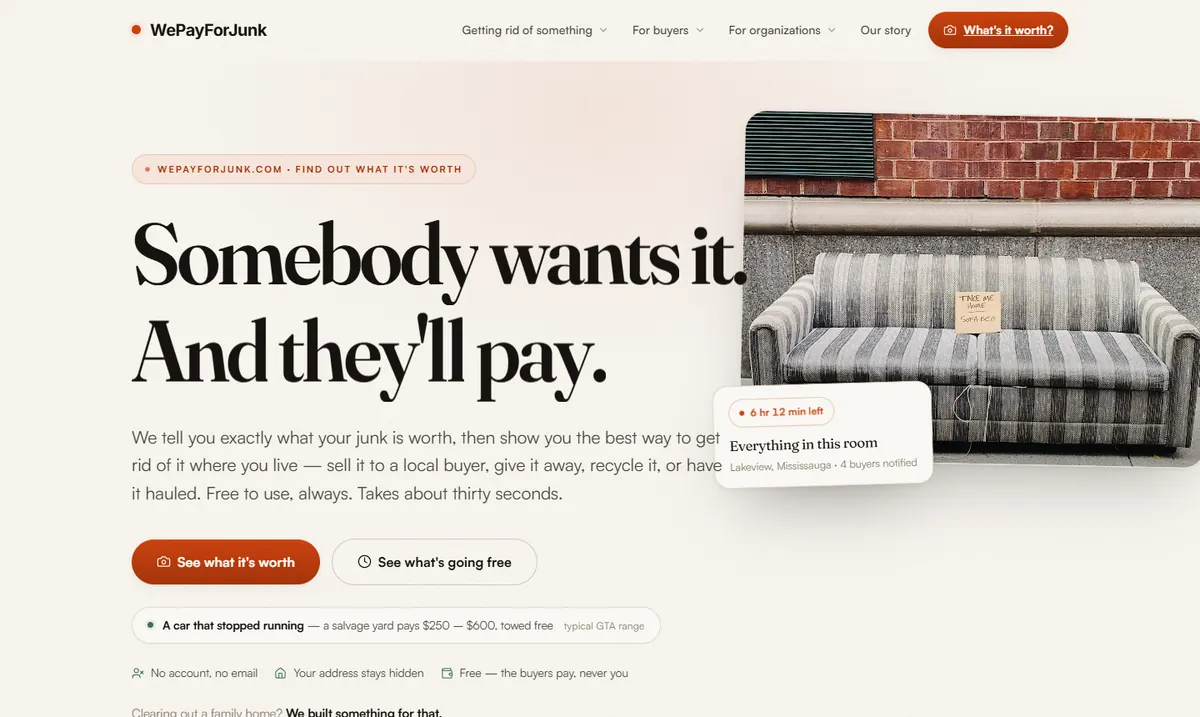
We Pay for Junk Somebody wants it. And they’ll pay.
A reuse prototype that tells you what your things are worth — including nothing — backed by checked sell and donate guides for 14 Canadian cities.
01 — The brief
The problem it solves
When a home has to be emptied on a deadline, useful things go into a dumpster because there’s no practical way to find the people who want them in time — and most people can’t tell which items are worth money and which are worth nothing.
The brief: say plainly what something is worth, including when the answer is nothing, then show the best way out where you live — sell it, give it away, recycle it or have it hauled — free to the person getting rid of it.
02 — What we built
Features that do real work.
What’s it worth?
Tap a category for two numbers — a private-sale range and what a buyer pays today — including the sofa that’s usually $0 and the piano that costs money to remove.
Where to sell it
Pawn shops, consignment, gold buyers, scrap yards and auto salvage, each with what it buys, what it refuses and how the deal actually works.
Where to donate it
Organizations that take used goods, with what each refuses and whether it will collect, checked against each one’s own website.
Value it for real
The one live form: photos, a postal code and an email, valued by hand while the buyer network is built.
Everything going free
A prototype giveaway feed with countdowns, filters and a stress mode of 1,000 placeholder items, all marked as sample data.
Receiver view & Diversion report
Demo screens for charities: standing wants, 24 hours of first look, and where every item went.
03 — How it's put together
Structure
Product views run as one page with their own paths through Netlify rewrites, each setting its own title, description and canonical. The guides are generated pages: 14 city hubs and 189 city-by-category pages across /sell and /donate, such as donating furniture in Toronto.
Under the hood
- Hand-written HTML, CSS and vanilla JavaScript on Netlify, with GSAP ScrollTrigger and Lenis for motion, Lucide icons, and Fraunces and Inter type.
- Netlify Forms takes the valuation form, including multipart photo upload and a honeypot field.
- One checked dataset of 344 sell, donate, recycle and wish-list records feeds both the guide pages and the in-app “where do I take it” matching; it loads only on first use, and wish-list charities are never matched to items.
- WebSite, Organization, City and FAQPage structured data on the home page; ItemList of Organization plus FAQPage on city guides; ItemList plus BreadcrumbList on category pages.
Details that matter
- Honesty is on the page: year-one numbers are labelled “Targets, not results — we haven’t launched,” and sample quotes are marked “Illustrative — not a real quote.”
- The sell guides decline to publish an average payout, explain how a pawn loan differs from a sale or consignment, and quote each shop’s published terms.
- A “Things we decided not to build” section: no messaging, no fees to sellers, no volunteer moderators, no eligibility checks, no reseller police.
Labelling every demo and target plainly lets a pre-launch product ship real, checked local guides now without borrowing credibility it hasn’t earned yet.
Want a build
like this one?
Tell us what you're launching. We'll tell you honestly what it needs — and what it doesn't.